Göttinger Knabenchor
 back
back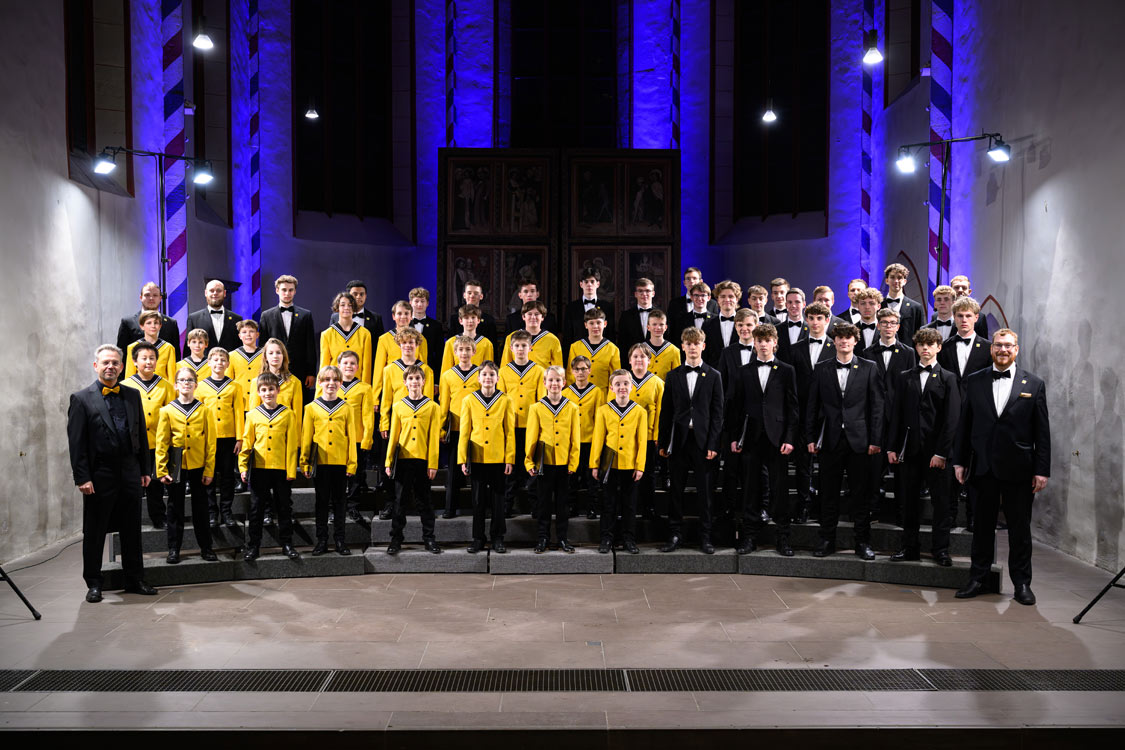
The Göttingen Boys’ Choir was founded in 1962 by the Kapellmeister, choral pedagogue, and composer Franz Herzog. The sonic ideal of the Dresden Kreuzchor – of which Herzog had been a member for many years as a singer and choir prefect – served from the outset as a model for the Göttingen Boys’ Choir and continues to shape its musical profile. The choir quickly gained an outstanding reputation both in Germany and abroad. Concert tours have taken it throughout Europe as well as to the United States, South Africa, and Japan. The choir fosters artistic exchange through numerous collaborations with renowned musical partners and through choral friendships with other boys’ and youth choirs.
The Göttingen Boys’ Choir performs sacred and secular choral music from all periods of music history. The art of a cappella singing with its particular challenges forms the foundation of its diverse repertoire. The repertoire also includes large-scale choralsymphonic works such as Johann Sebastian Bach’s Christmas Oratorio or George Frideric Handel’s Messiah, as well as contemporary music such as Benjamin Britten’s War Requiem, arrangements of folk songs or pop songs, and commissioned works for the Göttingen Boys’ Choir created for its project Singing For Future.
The Göttingen Boys’ Choir is particularly committed to preserving the compositional legacy of its founder, Franz Herzog. The Weihnachtsmusik that Franz Herzog (1917–1986) conceived and composed for his choir has been part of the ensemble’s musical DNA since its earliest days.
Beyond this, Herzog wrote a wide range of choral music: the Palmström Suite to poems by Morgenstern, Fluch des Krieges (Curse of War) to poems by Li-Tai-Pe, masses for boys’ choir, men’s choir and mixed choir, motets, arrangements of folk songs, psalm settings, music for orchestra and men’s choir, chansons and songs for choir, a fairy-tale opera, Händel-Historical as a “buffo operatorium” (a comic oratorio) and much more.
He also composed piano sonatas, orchestral songs, chamber music, works for large orchestra, brass compositions, an organ mass, and several song cycles for solo voice to texts by Rilke, Storm, Brecht, and others. Altogether, his catalogue of works comprises more than 200 compositions across a wide variety of genres. Much of it still awaits discovery.
Picture: Alexander Sparenberg
0 albums released by GENUIN classics
with Göttinger Knabenchor